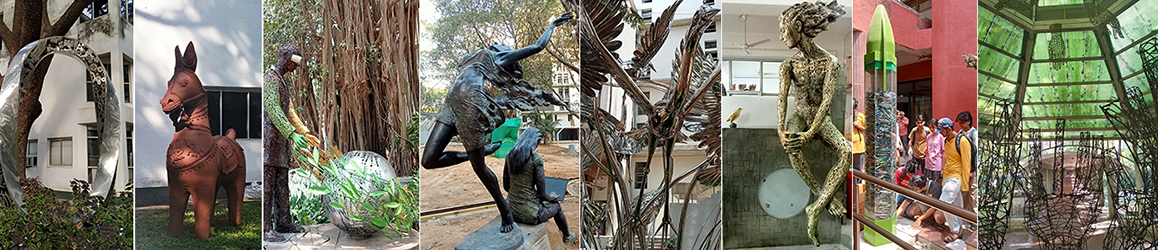
DE101 Art & Design Fundamentals
Course
Objectives (Week 1)
Is art an expression? If so, is all expression, art?
Is art in an object? Is design a product?
Some Food for Thought
Design, in contemporary times, arose in the West as a humanizing response to the rapid industrialization. In its initial movements it appeared as the Art Noveau movement and at Bauhaus and later at the Ulm school in Germany;
Unlike modernism that was characterized by a search for universal truths, the postmodern view was inclined to subjective knowledge as the dominant form of discourse.
Globalization is a relatively new phenomenon the implications of which are yet to be understood. The diffusion of digital technologies and the emergence of artificial intelligence is likely to disrupt our earlier approaches to design.
In times of stress and confusion in our outer and inner lives, it would perhaps be wise to go slow and to turn to a balance between our mind and body; our heads and hands.
Formulating through observation and analysis some of the fundamentals of art and design.
Understanding through practice, some of the processes, in art and design.
Is design, 'problem-solving'? If so, is all problem solving, design?
Is art sensual / conceptual / intellectual / spiritual?
If design is something that serves the needs of people, how does it respond to the needs of complex and diverse societies, such as India?
What connects art and design? And what differetiates them?
These are some of the questions that the course shall grapple with.
The widespread diffusion of cultures in the 21st century have led to the emergence of a global art circuit that is linked closely with market mechanisms. While artists have sought to infuse their works with references to local
or national cultures, art-works have come to bear an affinity to various other commodities on offer at the marketplace. New forms of art that resist such commodification have emerged, but it appears that the arts no longer serve
as containers for the highest aspirations of human kind, as they once did.
a few decades later it appeared as the spirit of innovation and entrepreneurship that characterized mid-nineteenth century America.
These approaches were key influences in the formative years of design education and practice in modern India.
Thus notions of design that had characterized the modernist era with its emphasis on objectivity and universally applicable ideas of aesthetics underwent changes that sought to reflect the ‘local in the global.’
Unlike earlier forms of colonization (that were physical), new forms of colonization appear to control by a mediated capture of peoples' imagination. How would we distingush the real from the fake?
Groups / Attendance / Evaluation
View here
Date
|
Screenings / Slide-Talks | Readings |
27
July 2026
|
Glass / Learning to Walk / The Story of Stuff / What is Design? | Eames Report |
28
July 2026
|
Journeys in Clay / Sapiens | Do Hands have a Chance / KG |
30
July 2026
|
Bombay: Hamara Shahar / Sketching Chhaya | Handmade in India |
30
July 2026
|
Sketching Chhaya | |
1
August 2026
|
Museum Visit | |
6/11
August 2026
|
Schooling the World: The White Man's Last Burden | |
13
August 2026
|
On Education / Sapiens |
Select References
Additional References
Journals and Magazines
Books
Devi Prasad, Art the Basis of Education , NBT, 2001
Gupta Shyamala, Art, Beauty and Creativity (Indian and Western Aesthetics)
Yanagi Soetsu, The Unknown Craftsman, Kodansha, USA, 1984
Ghosh Aurobindo, The National Value of Art, SABDA, 1999
Subramanyan K.G., Do Hands Have a Chance, Seagull, 2010
Eames Charles and Ray, The India Report, NID, 1958
Ranjan Aditi and M.P., Handmade in India, Mapin, 2024
Bhatt Ela, Anubandh (Building Hundred-Mile Communities), Navjivan Trust, 2015
Spivak Chakravorty Gayatri, An Aesthetic Education in the Era of Globalization, Harvard University Press, 2012
Gropius Walter, Bayer Herbert, Bauhaus (1919 - 1928) MoMA New York, 1938
Wingler Hans Maria, Bauhaus, MIT Press, 1969
Droste Magdelena, Bauhaus (1919 - 1933), Taschen, 2002
Muller Lars, Bauhaus Journal (1926-1931), Lars Muller, 2019
Penin Lara,The Disobedience of Design:Gui Bonsiepe, Bloomsbury, 2022
Muller Jens, A Concise History of the Ulm School of Design, Lars Muller, 2014
Subramanyan K.G., The Magic of Making, Seagull, 2010
Marg
Art India Magazine
Visible Language